
Of the various operational activities your nonprofit navigates, payroll is among the most complex. This process bridges financial management and human resources, meaning it often involves input from multiple professionals and the application of several different skillsets. Plus, there are many requirements surrounding payroll for nonprofits, which your organization has to follow without getting distracted by common misconceptions about the process.
To help clear up the confusion, this guide will cover the basics of payroll for nonprofits, including:
Let’s get started by discussing what payroll entails and why it matters in a nonprofit context.

Nonprofit payroll is the process of managing the distribution of employee compensation for a tax-exempt organization. It involves everything from ensuring compliance in tax withholding and reporting to actually paying staff members on a regular schedule.
As long as your nonprofit has official employees (i.e., it isn’t 100% volunteer-run), you’ll need a payroll process. Your organization has obligations to the federal government as an employer and to your staff to compensate them for their efforts to drive your mission forward—both directly through salaries and other monetary compensation and indirectly through benefits like health insurance and paid time off. Effectively managing payroll allows you to fulfill all of these commitments and keep your nonprofit in good standing with its various stakeholders.
Like most financial activities, payroll works somewhat differently at nonprofits than at for-profit organizations due to the unique rules and regulations nonprofits have to follow to maintain their tax-exempt status. A few areas of distinction between these two payroll processes include:
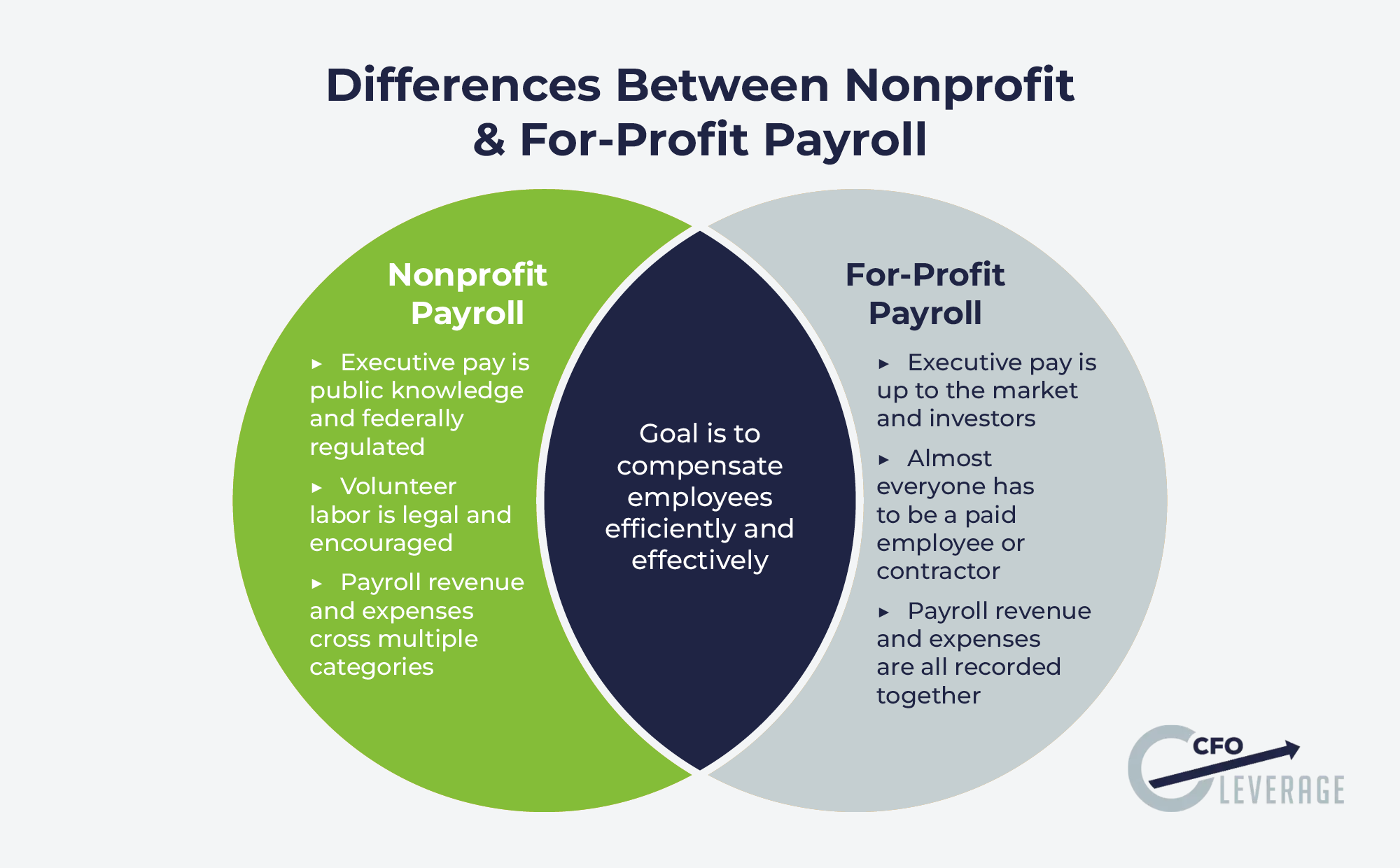
These differences underscore the importance of using payroll services or software that are designed to handle the complexities of nonprofit payroll (more on this later, too!).
Your nonprofit should report payroll spending—along with all of its other expenses—according to the function it serves in furthering your mission. This means you need to track how much of your employees’ time goes toward the following activities:
From there, you can figure out what percentage of your employees’ salaries serves as compensation for each type of activity, then record your payroll spending accordingly on your financial statements and tax returns.
The short answer to this question is yes. The longer answer is that exempt organizations pay some of the payroll taxes that businesses do, but not all of them.
Here is a quick breakdown of US payroll taxes and whether your nonprofit pays them:
The complexities of these requirements are why it’s helpful to consult nonprofit financial professionals throughout the payroll process, since they’ll understand these different taxes and ensure you pay what you need to to stay compliant while not spending unnecessary money on taxes you’re exempt from.
Now that you’ve gotten the lay of the land with nonprofit payroll, let’s walk through how to implement an effective payroll process at your organization. Feel free to browse through the steps below, or use the following checklist to keep your nonprofit on track as you dive into setup!
If your nonprofit is incorporated and registered as a 501(c)(3), you’ve already completed half of this step. Your organization should have been assigned an Employer Identification Number (EIN) upon filing Form 1023 with the IRS, and the state your nonprofit operates in should have also issued it a tax identification number when you registered your organization with that government. Both of these numbers are essential for proper payroll processing and reporting.
Additionally, you’ll probably need approval from your nonprofit’s board of directors to open a payroll account. It likely won’t be difficult to get this approval as long as your board understands that it’s more efficient to have a separate bank account for paying employees than it is to take salaries and bonuses out of your organization’s main account. However, your bank might require you to submit a board resolution when you open your payroll account for insurance purposes.
Before you start running and reporting payroll, you’ll need to have important information on file for your employees, such as their mailing addresses, Social Security Numbers (SSNs), tax filing and work eligibility statuses, and details on dependents. You’ll collect these details using the following forms:
Having these forms on file from the beginning of a staff member’s employment at your nonprofit or a contractor’s working relationship with you ensures you issue them the right tax return. For employees, these forms ensure you withhold the right amount from each paycheck. Plus, you won’t have to chase anyone down for critical details as tax filing deadlines approach.
Once you have your identification numbers, payroll bank account, and employee information, the last resource you’ll need to get started is either a software solution to help you run payroll in-house or a service provider you can outsource this responsibility to. Whichever route you choose, make sure to:
Additionally, payroll should never be the responsibility of just one person. If you run payroll in-house, have at least two staff members review your software’s work each month to catch and fix any mistakes before they cause problems. If you outsource payroll, ensure your provider uses a system of checks and balances to ensure accountability.
After you run payroll for each pay period, make sure your nonprofit’s financial records account for all relevant expenses. If you’re using payroll software and it’s possible to do so, integrate that solution with your organization’s accounting platform so data can transfer automatically between systems, saving your team time and reducing the risk of mistakes.
During this process, double-check that you’ve properly allocated functional time so your accounting data is in good shape for accurate reporting and budgeting. Plus, if your nonprofit undergoes an independent financial audit, proper categorization of payroll expenses is a key factor your auditor will look for, so it never hurts to be prepared.
Many tax forms involve reporting payroll data, especially for nonprofits like yours because of your exempt status. A few federal forms you should know include:
You’ll probably also have to file separate forms with your state government, especially regarding your decision about SUTA/SUI payments. These varied deadlines can be difficult to track, so consider creating a tax filing calendar to help your team get all required forms in on time, and use the breakdown below as a reminder of all of the federal forms that apply to payroll.

To help you complete the third step in the process above, we’ve compiled a few options for trusted nonprofit payroll services (if you’d prefer to outsource the process) and popular software (if you’d rather run payroll in-house). Besides your preferences for task ownership, make sure to consider your organization’s budget and number of employees when choosing a solution, as well as whether other similar nonprofits have used the provider or tool and what they thought of it.
CFO Leverage is a leading provider of bookkeeping, accounting, and fractional CFO services to nonprofits of all sizes across the United States. While our team mainly focuses on improving financial recordkeeping and strategy for clients, payroll administration is a popular add-on to our service plans, meaning organizations can pay for what they need, when they need it.
Because CFO Leverage’s payroll services are always built on a foundation of essential financial services—whether you choose the Compliance plan for bookkeeping support or the Strategic plan for higher-level advisory needs—you can be confident your payroll will be processed and recorded correctly. Our goal is to leverage our skills so you have the resources and time you need to maximize your organization’s impact!
ADP is a payroll and HR solution used by more than 1 million organizations of all sizes and in all industries, including many in the nonprofit sector. In addition to scalable, integrated payroll tools, ADP offers time tracking features, HR compliance auditing, outsourced management options, and other helpful services and software for nonprofit users.
Gusto is a comprehensive payroll platform that primarily serves small to mid-sized businesses and nonprofits. It stands out for its user-friendly interface, easy contractor management, and consolidation of every aspect of employees’ total compensation packages (paychecks, reimbursements, health insurance, paid time off, retirement benefits, etc.) into one solution.
OnPay also focuses on meeting small to mid-sized businesses’ and nonprofits’ needs when it comes to payroll and HR technology. This platform is particularly notable for its extensive reporting features and analytics dashboards, as well as its mobile payroll processing capabilities and transparent pricing structure.
Paylocity is a platform that combines finance, HR, and IT functions into a unified solution for nonprofits and businesses of all sizes. Since payroll bridges finance and HR, Paylocity breaks down data silos between those departments to ensure compliance and consensus. This solution’s payroll function can also handle advanced needs like wage garnishment and on-demand payments, if your organization is looking for those capabilities.
Although payroll can be a complex process for your nonprofit, it’s essential to ensure financial stability, maintain compliance, and boost employee satisfaction and retention by compensating them appropriately for their hard work on behalf of your mission. Use the tips above to get started, and remember that you can always outsource payroll services to nonprofit financial experts (like our team at CFO Leverage!) if you need help or have questions along the way.
For more information on payroll for nonprofits and how it fits into the bigger picture of financial management, check out these resources in our blog: